
10.2025
FMC // November 2025. Our upcoming events
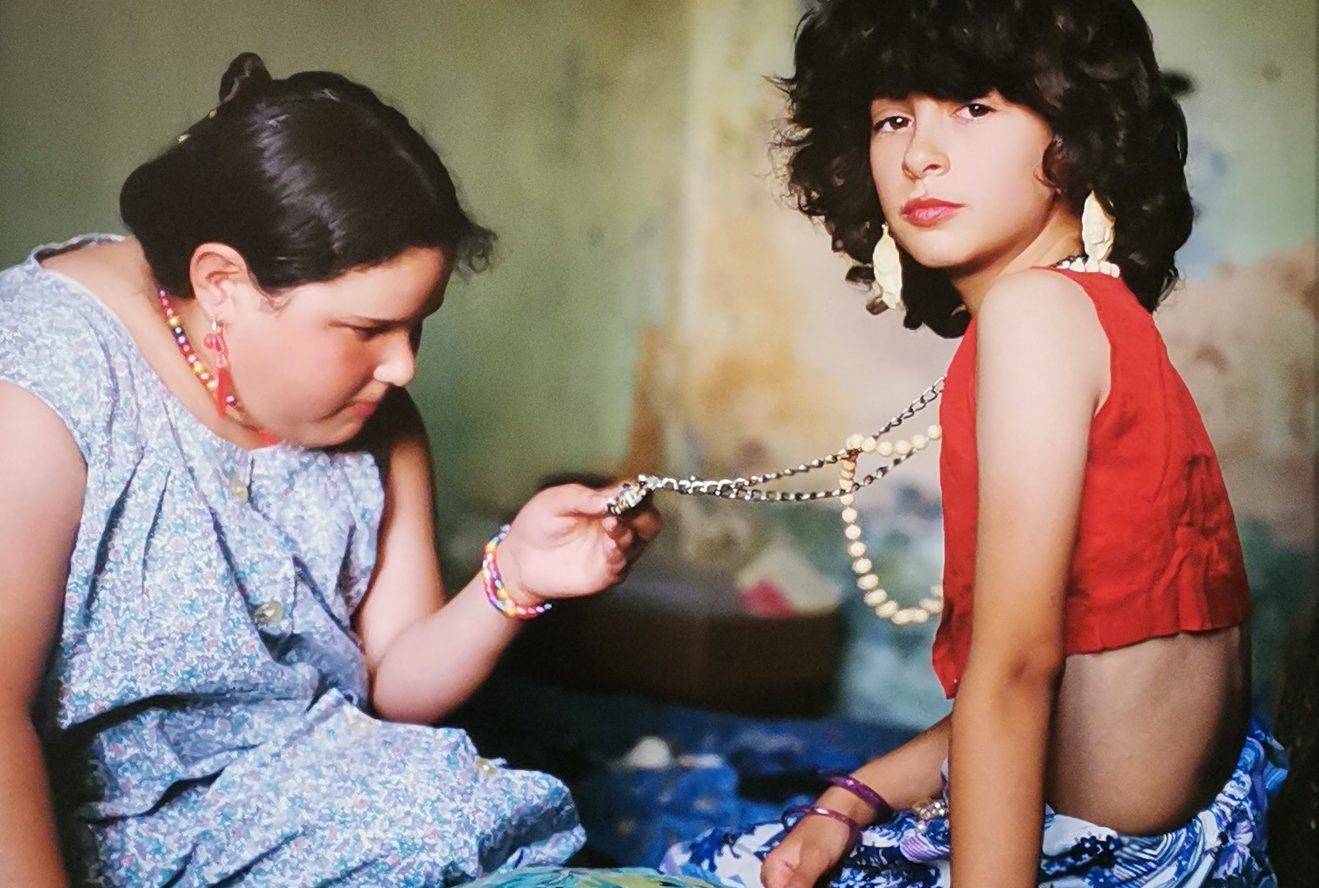
Photo: The Necklace, 1999 @Alessandra Sanguinetti at C/O Berlin
2.11 / Discovering the Myths of… The Lifetimes Tour
An unmissable event of music and pop culture for FMC.
American superstar Katy Perry lands at Bologna’s Unipol Arena for the only Italian date of her world tour.
With over 115 billion streams, 70 million albums, and 143 million singles sold worldwide, Katy Perry remains one of the most beloved artists of all time.
13.11 / Discovering the Myths of… The Mayhem Ball
The concert-event of the year: Lady Gaga returns to music after her cinematic ventures with a monumental show suspended between decadent baroque and dark neo-gothic aesthetics.
FMC will be in the Golden Circle at Lyon’s LDLC Arena (FR) for an exclusive live report.
17.11 / Discovering the shock-rock myths and the gothic-industrial aesthetics of Marylin Manson
With his world tour One Assassination Under God Tour, Marilyn Manson fuses a highly theatrical visual style — iconic makeup, altar-like stage sets, and powerful symbolism — into a performance exploring religious imagery, social decay, transformation, and rebirth at a time when our world is once again reflecting on the threat of global conflict.
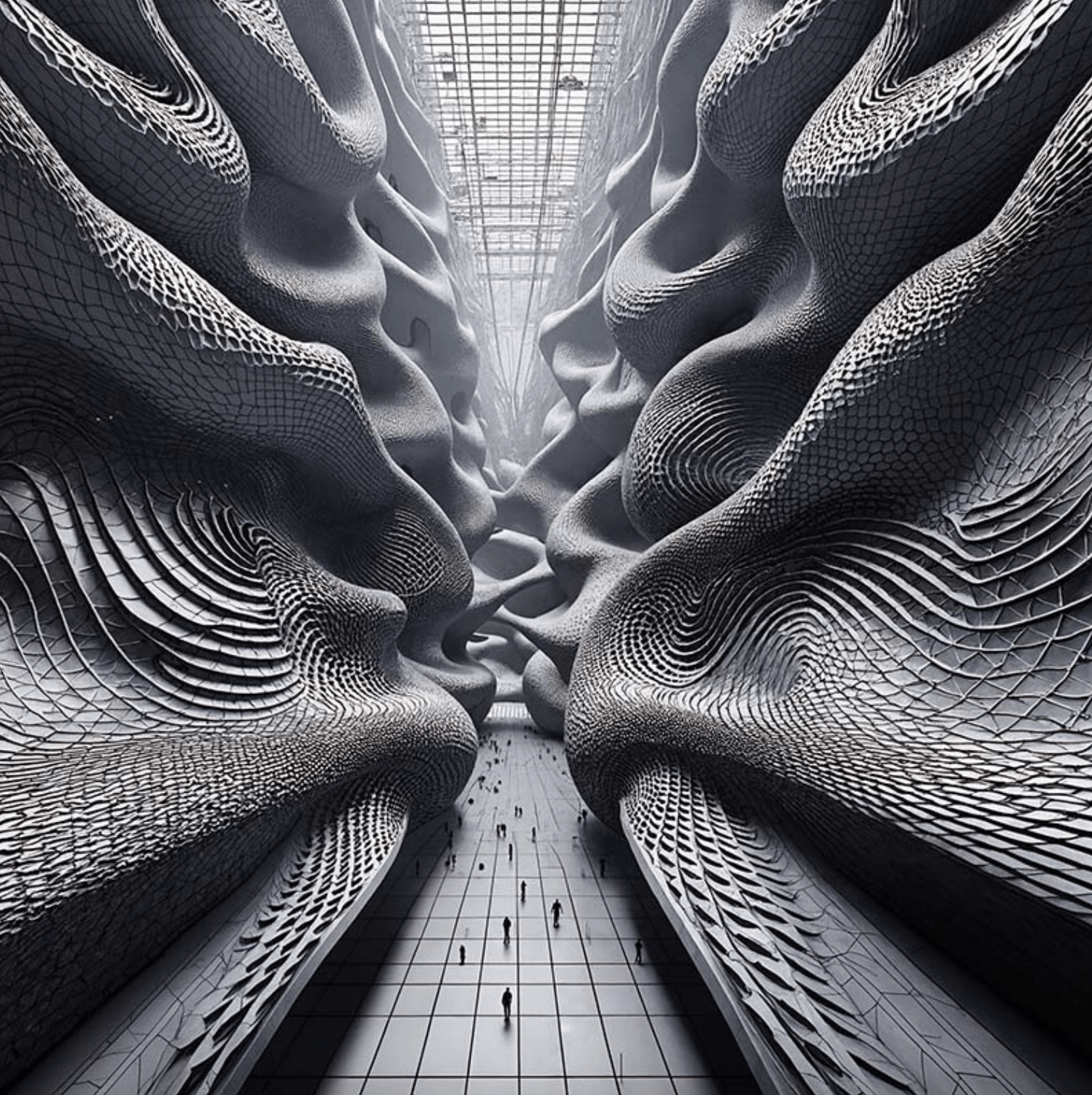
19–21.11 / FMC in Córdoba, Argentina for SiGraDi 2025
Meta-Responsive Approaches in Architecture, Art, Design, and Sciences
SiGraDi 2025 immerses us in the world of responsive design, exploring adaptive and flexible solutions in architecture — and in cultural project development — that can effectively respond to the ever-evolving needs of both people and ecosystems.
Here, we will present our research See the Invisible: Using Generative AI to Represent Mythical Layers in Immersive Panoramas, while deepening our understanding of “Eternal Cities.”

24.11 / Off to New Zealand!
GDI 2025 Green + Digital + Intelligent Built Environments
GDI 2025 will allow us to explore cutting-edge research and transformative practices shaping the future of the built environment — from sustainable construction and advanced structural systems to smart cities and digital transformation.
Together with the M-Cube Foundation, we will present the paper
See the Invisible. How Generative AI Can Support Panorama Artists in Representing Spaces in a Deeper Way, while further investigating the idea of “Eternal Cities.”
We will also lead a professional workshop on phygital panoramic environments and present the new demo of the See the Invisible exhibition.
The Fantamoda
by Fabrizio Modina
Out there, in the so-called “real” world — among the alpha males who couldn’t care less about the difference between turquoise and cerulean — people play Fantasy Football, that curious homemade offshoot of sports betting which has now evolved into a proper business.
If a Fantasy Fashion League existed, this season — between Milan and Paris — I’m quite sure I would have earned a considerable sum by predicting the goals and own goals of the great names of the fashion system.
The game of reshuffles, comebacks, and rebirths seemed to have crystallized all within a single season: Spring/Summer 2026. It was worth placing a bet, just to make sure everything would change — so that nothing really would. More or less.
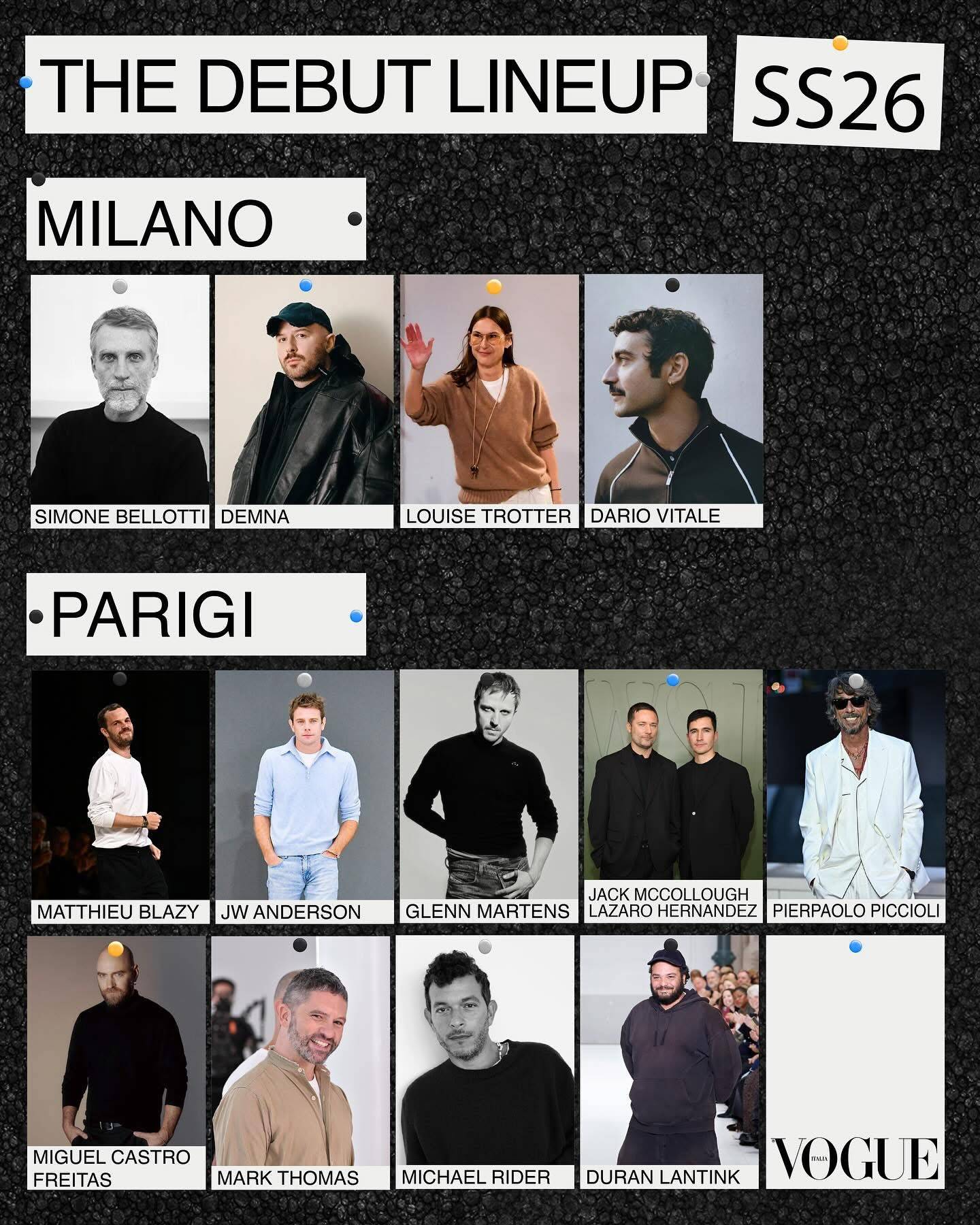
Photo: VOGUE
And immediately, a miracle was announced (by the press office, of course): no runway show, but a short film filled with global celebrities playing the roles of a colourful, dysfunctional family.
The media and social networks got crazy, while I remained incredulous that no one seemed to notice the elephant in the room: there was no collection. Or rather, what little could be seen — about 80% recycled from Tom Ford’s glory days — was shamelessly promoted as a see-now-buy-now line. Translation: we’ve turned into fast-fashion wholesalers from Centergross, but hey, we’re still f**ing cool*.
The worst fate, however, befell Versace — though it didn’t take a psychic to foresee it. When a Maison that built its entire heritage on physicality, sex, and excess is acquired by another with a diametrically opposite history, the result can only be discordant and disorienting. The outcome is a pastiche of archive themes from different eras, which the new designer Dario Vitale clumsily glues together — almost childishly — like paper dolls on the shapeless, worn-out silhouettes of Prada. From Supermodels to zombies, Medusa is once again beheaded, and those few who dared to cry scandal were, of course, petrified.
As for Armani, for obvious reasons, the models could have walked in papier-mâché outfits and it still would have been a standing ovation. The King is dead, long live the King. Good luck to whoever will have to carry such a heavy legacy — fully aware of the need to rejuvenate a brand whose loyal clientele starts, and ends, around the age of fifty.
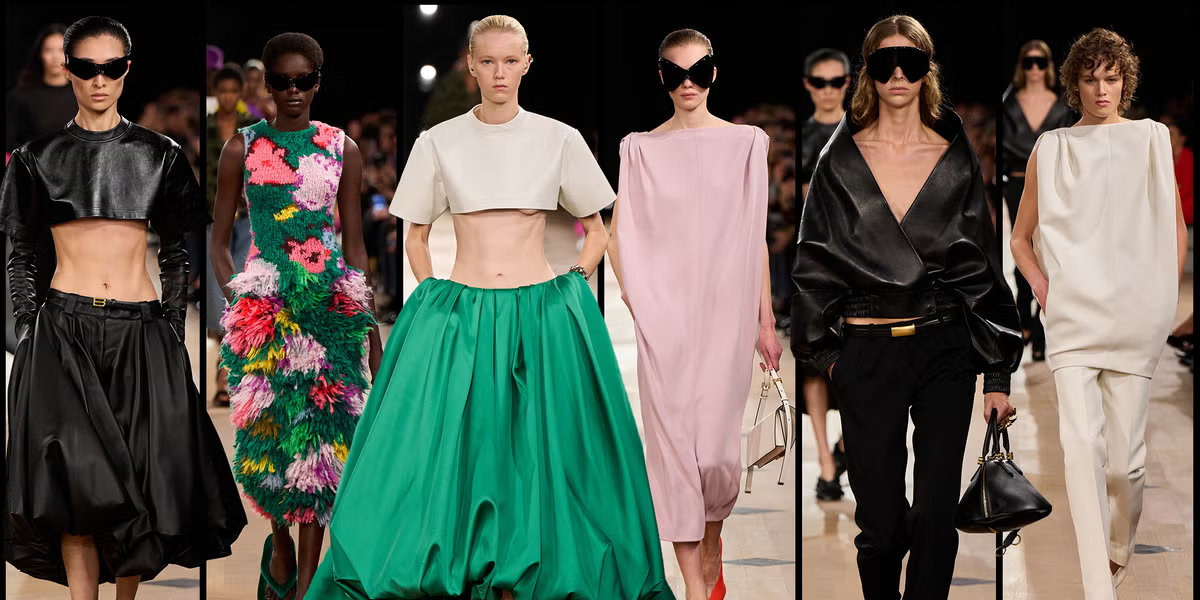
Photo: Balenciaga
Beneath the Eiffel Tower, all the thrill is at Dior, which bids farewell to Maria Grazia Chiuri (already comfortably settled at Fendi) to celebrate the debut of Jonathan Anderson — one of the very few genuine enfants prodiges of an otherwise largely underwhelming generation of designers. After turning Loewe into a phenomenon, the Northern Irish creative has now agreed to take the reins of Dior’s womenswear, menswear, and haute couture, all while keeping his own namesake brand, his Uniqlo collaboration, and his work as a film costume designer.
John Galliano lasted fourteen years before losing his mind, so one can only wish Anderson the best — if nothing else, for his courage and endurance. The collection is hybrid and at times confused, yet the details show exquisite craftsmanship, the footwear is a delight, and the silhouettes are intriguing. It will be the Haute Couture collection that truly determines whether the designer’s vision can fuse with the brand’s essence — but we trust in his talent.
Equally positive was Pierpaolo Piccioli’s debut at Balenciaga, though he is not easily forgiven for having handed over “his” Valentino to the rather inept hands of Alessandro Michele.
Piccioli faces the difficult task of restoring Balenciaga to its original status — that of a laboratory for the experimentation of form and architecture, rather than an emporium of sneakers and t-shirts for wealthy Asian teenagers. More couturier than designer, Piccioli enters the archives of one of fashion’s greatest geniuses with humility, seeking a balance between past and present, while taking the bold risk of a radical shift in clientele.
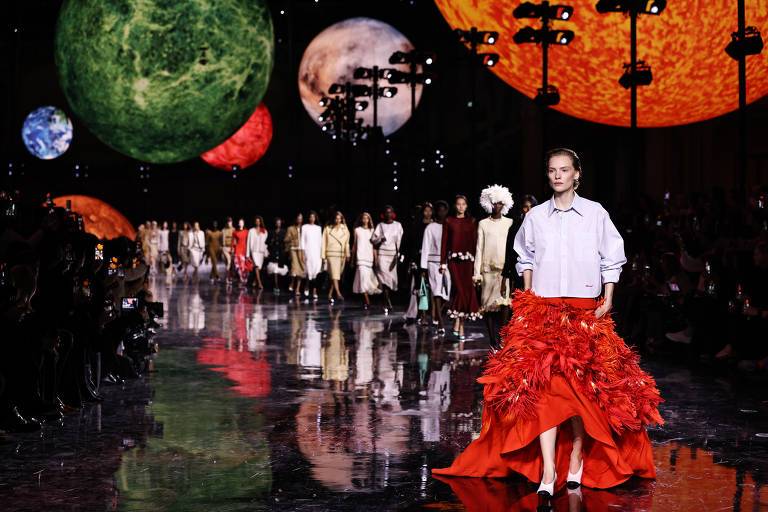
Photo: Channel
Last but not least, the Parisian week came to a close with Chanel — the other great question mark of the season.
Will Matthieu Blazy be able to revive France’s most iconic — and most soporific — brand? The answer, thankfully, is yes.
With a single snap of the whip, the post-Lagerfeld era — ruled by Virginie Viard’s pseudo-intellectual bourgeois touch — is gone.
Blazy conducts a symphony of lightness and youth, sending a message to a new generation of clients.
On the runway, there are smiles — even a little dancing — to the gloriously kitsch notes of Rhythm Is a Dancer. The message couldn’t be clearer: we’re rich, we’re snobbish, but we don’t have to be embalmed matrons.
And so, in a game of musical chairs that not even Giulio Andreotti could have orchestrated better, everyone has found their place.
The talented ones, the less talented ones — all accounted for.
The circus goes on, as we wait for the arrival, sooner or later, of a new, true genius.
Fashion, a profession in evolution
Discover the video talks by Fondazione M-Cube, starting with fashion and then gliding into many other worlds of Modern Mythology!
Double Zip
curated by Grita
filming and editing by Simona Rapisarda
The New Languages of Fashion: Video Games and the Metaverse
Fashion, video games, and the Metaverse come together in the story by Leonardo Assom. Technical “know-how” also takes shape in the digital realm, while the boundary between play and reality becomes increasingly thin…
Discover the FASHION HERITAGE ACADEMY
300 hours of specialization for professionals


Contact & Info
educational@fondazionemcube.it
Segretariat +39 392.6328942 // From Mon to Fri – 14.00-16.00
Fashion on the Big screen: The Addams Family – curated by Elena Maria Casella
Halloween is approaching, and we can’t say goodbye to October without opening the doors of the most fascinating and eerie mansion on the big screen. Amid cobwebs, old candelabras, and a disembodied hand wandering through the rooms, the Addams family welcomes us every year with their timeless charm.
In a world still hostile to diversity, they have made it their defining trademark: elegant, eccentric, and proudly unconventional, the Addams have transformed the gothic into style and the macabre into a form of eternal sophistication.
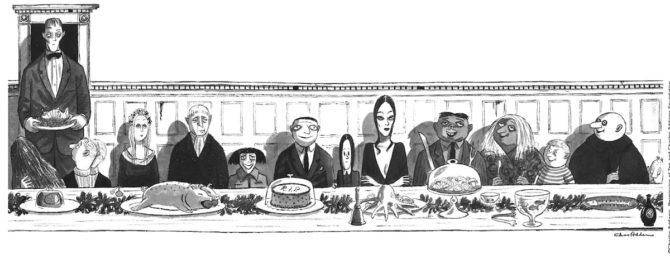
The Addams Family was born in 1938, created by cartoonist Charles Addams, who brought to life a series of ironic vignettes in the pages of The New Yorker. These black-and-white illustrations depict fragments of the life of a seemingly “monstrous” family, but one that is actually much more affectionate and close-knit than the perfect American bourgeois households of the time.
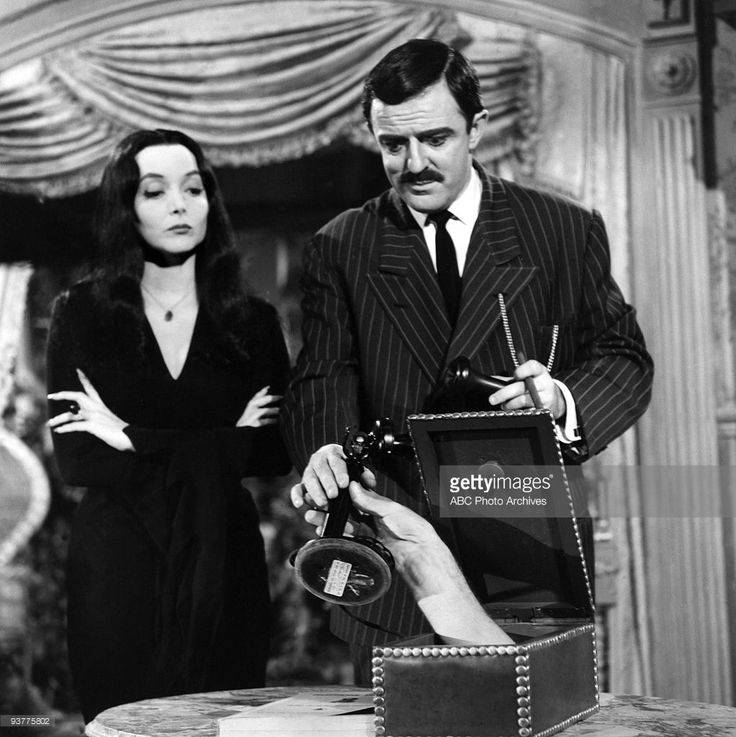
In 1964, the characters came to life on screen thanks to the television series broadcast on ABC. The sophisticated sarcasm of the cartoons became a distinctive language where the dark meets comedy. Morticia, with her flowing silhouette and mermaid-style dresses, instantly became a style icon; Gomez, in his pinstriped double-breasted suit with a cigar in hand, represented a new form of eccentric and chivalrous masculinity.
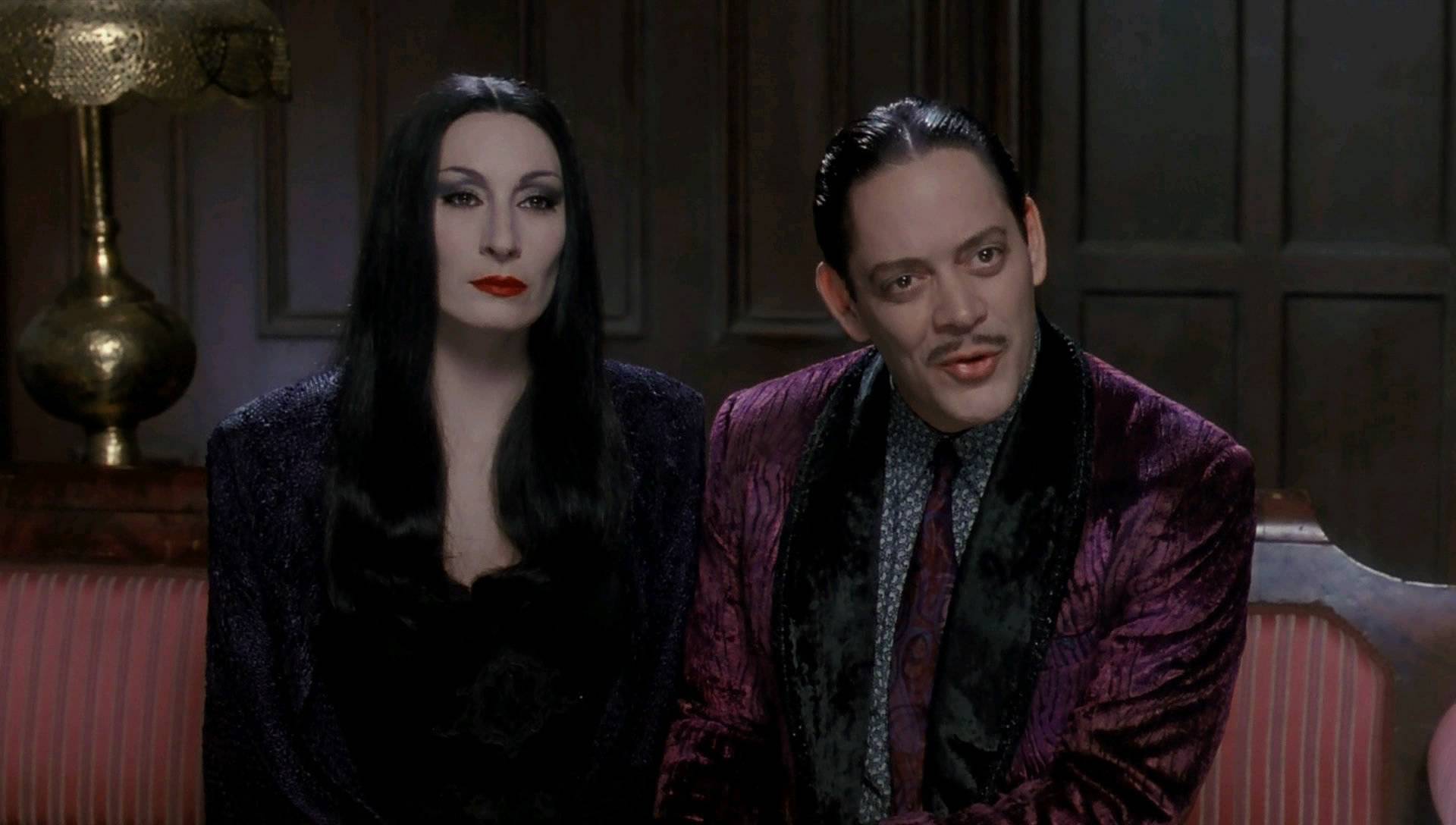
But it was with Barry Sonnenfeld’s films in the 1990s that the family reached its cinematic peak. Under his direction, the world of the Addamses was imbued with an even more glamorous and theatrical gothic aesthetic. Much of the credit goes to costume designer Ruth Myers, who created a visual language that speaks as much to fashion as it does to the history of costume. Her influences ranged from 19th-century decadence and the Victorian era, to 1950s haute couture, and even surrealist tones.
Myers explains that the true goal was to make Morticia (Anjelica Huston) appear to “float” like a goddess, as if she did not entirely belong to the world of the living. This effect was achieved through the clothes she wore—outfits that cemented her immortality in the collective memory. It was at this moment that the Addams Family definitively became a modern myth, foreshadowing by decades the contemporary fascination with dark chic and goth fashion, now thriving on runways and social media.
With Tim Burton’s Wednesday series (Netflix, 2022), this aesthetic has forcefully returned to the center of pop culture. Young Jenna Ortega breathes new life into the character, becoming an “aesthetic manifesto.” Her wardrobe inspired the new social media trend dubbed “Wednesdaycore”: a revival of gothic style interpreted in a minimal, clean, and contemporary way.
But the moment that most firmly establishes Jenna Ortega as the contemporary heir to the Addams mythology is the look she chose for the premiere of the show’s second season. On the carpet, the actress wore an ensemble by Ashi Studio – a corset, top, and sheer latex skirt – that set the internet ablaze for weeks.
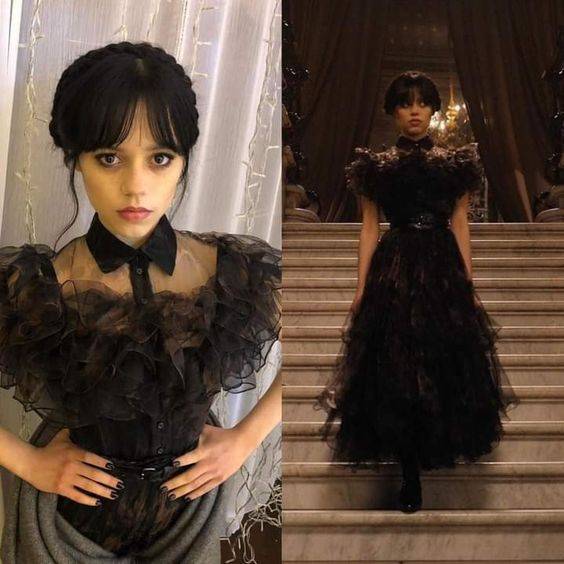
For over sixty years, the Addams Family has continued to inhabit our imagination. They have challenged conventions, turning horror into style and diversity into beauty. While society has often regarded them with suspicion, fashion has crowned them as its muses, celebrating their theatricality and love for the unusual. Morticia, with her mermaid-style gowns; Wednesday, with her iconic toughness; Gomez, with his timeless dandy charm—each character is an archetype that continues to resonate in contemporary visual culture. Today, with Jenna Ortega as the new dark muse, this mythology is renewed, proving that being an Addams is not odd—it is an act of aesthetic freedom.
Ultimately, their story offers a profound style lesson: do not fear being yourself, even when conformity is easier. As Morticia might say, with a smile and a flutter of her lashes: “Normal is an illusion. What is normal for the spider is chaos for the fly.”
MiniMyths – in collaboration with Scuola Internazionale Comics

in collaboration with Scuola Internazionale Comics
After an extraordinary year together with the students and teachers
of the International School of Comics… the new column MiniMyths arrives —
to explore together what Modern Mythology really is.
The Journey of Jeans
by Sonia di Sciacca

FMC // September 2025. Results and ongoing projects
NEW FORMATS FOR YOU
In the works for you… the irreverent magazine LETTERALMENTE (curated by Grita). And that’s not all… a magazine directly from the world of cosplay with Angela De Marco, a film review series with Nicolas Casari, and a podcast with Giorgia Casari to explore real life, challenge prejudices, and find the courage to engage with all human issues.
RESEARCH & INNOVATION
The research of the M-Cube Foundation continues in collaboration with the New York Institute of Technology (USA), Auckland University of Technology (NZ), HTW Berlin (DE), and Universidade Aberta (Lisbon, Algarve – PT). We are studying how Modern Mythology permeates and impacts spaces (the “Myth Cities” – a first chapter of which was presented at KUI 2025 at the Kulturforum in Berlin).
EU PROJECTS
Currently in the application phase, in collaboration with 40 partners across Europe, the USA, and New Zealand, REBORN – a new important project is being proposed in response to the latest Horizon calls.